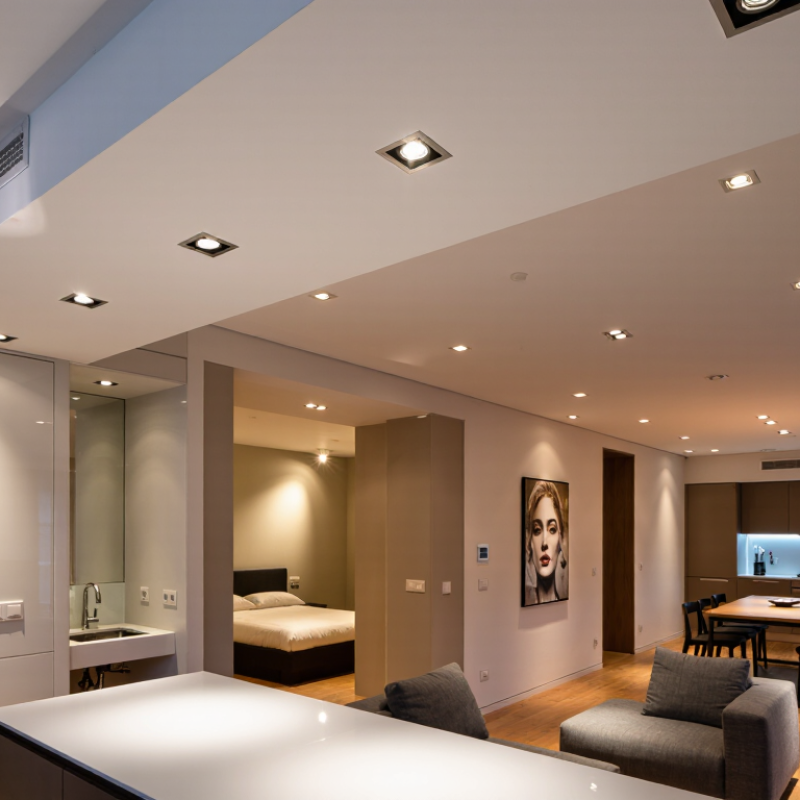
| Fixed Recessed Downlight | Best for general lighting
Living rooms, bedrooms, hallways, offices and circulation areas | Approximately 60°–120°, depending on the lamp or LED module | Requires a ceiling cut-out and sufficient space for the housing, driver and wiring | Flat ceilings where the light direction does not need regular adjustment | Simple appearance, efficient installation and even ambient illumination | The light direction is fixed; spacing and beam angle must be planned carefully |
| Adjustable or Gimbal Downlight | Best for directional lighting
Art displays, feature walls, retail areas, sloped ceilings and task zones | Commonly 24°–60° for accent or focused lighting | Needs a compatible adjustable trim and adequate clearance for tilt movement | Flat or angled ceilings where the beam must be aimed at a specific surface | Directs light toward artwork, shelving, worktops or architectural details | Tilting can create glare or visible dark areas if the fixture is poorly positioned |
| Low-Profile or Slim Downlight | Best for shallow ceiling voids
Renovations, apartments, corridors and ceilings with limited plenum depth | Usually 90°–120° for broad general illumination | Requires less recess depth than many traditional housings, but still needs driver access and wiring space | Shallow suspended ceilings, plasterboard ceilings and retrofit projects | Solves depth limitations and usually provides a clean, unobtrusive finish | The remote driver may require a separate accessible location; verify heat management |
| IC-Rated Downlight | Best near insulation
Insulated residential ceilings and areas where insulation may contact the fixture | Varies by design; approximately 60°–120% for general models | Must be specifically marked and installed according to local electrical and fire-safety requirements | Ceilings with insulation around or over the recessed housing | Designed to manage heat when installed in permitted insulated assemblies | “IC-rated” requirements differ by jurisdiction; do not cover or modify the housing unless permitted |
| Fire-Rated Downlight | Best where ceiling fire integrity matters
Multi-level homes, apartments and ceilings separating floors or protected rooms | Commonly 60°–100%, depending on the optical design and certification | Requires a tested fire-rated assembly with the correct fitting, driver, cut-out and ceiling construction | Plasterboard or other ceiling systems requiring a specified fire-resistance period | Helps maintain the tested fire performance of a compatible ceiling system | Fire rating is installation-specific; the fixture alone does not guarantee the whole ceiling rating |
| Damp-Rated Downlight | Best for humid areas
Bathrooms, laundry rooms, covered porches and utility areas | Approximately 60°–120%, based on the intended lighting purpose | Requires a suitable moisture rating and installation within the electrical zone permitted by local codes | Areas exposed to humidity, condensation or occasional moisture; wet locations may require a higher rating | Better protection against moisture than standard dry-location fixtures | Damp-rated does not automatically mean suitable for direct water spray or immersion |
| Wet-Rated Downlight | Best for direct water exposure
Shower areas, exterior soffits and other locations exposed to splashing water | Often 60°–100%, with the final choice based on coverage and glare control | Must carry the required wet-location certification and be installed with suitable seals and connections | Locations where water can contact the fixture directly, subject to local regulations | Provides greater protection against water ingress than dry- or damp-rated products | Confirm the permitted installation zone, IP or equivalent rating, and compatibility with the ceiling system |
| IP65 or Higher Downlight | Best where dust and water protection are specified
Bathrooms, shower ceilings, exterior soffits and dusty service areas | Commonly 60°–100%; narrow beams suit accents, wider beams suit general lighting | Requires the stated ingress-protection rating for the exposed front or complete fitting, as specified | Moist or dusty locations where an IP rating is required by the project specification | Provides a clearly defined level of protection against solids and water ingress | The IP rating does not replace electrical-zone rules, fire requirements or correct sealing |
| LED Retrofit Downlight | Best for upgrading existing fittings
Residential refurbishments, commercial upgrades and energy-efficiency projects | Typically 80°–120% for broad replacement lighting; some models are narrower | Requires matching the existing cut-out size, supply voltage, driver arrangement and mounting method | Existing recessed apertures where the new module is compatible with the housing | Can reduce energy use and maintenance compared with many older lamp technologies | Check dimmer compatibility, heat dissipation, color temperature and the condition of the existing housing |
| Smart or Dimmable Downlight | Best for flexible control
Living areas, bedrooms, hospitality spaces and smart-home installations | Usually 80°–120% for ambient lighting, with narrower options for accent use | Requires compatible controls, wiring, dimmers, gateways or wireless network coverage as applicable | New or existing ceilings where control infrastructure and driver access can be provided | Enables dimming, scheduling, scene setting and sometimes adjustable color temperature | Confirm minimum load, dimmer compatibility, wireless reliability and standby power behavior |
| Color-Tunable Downlight | Best for changing atmosphere
Hospitality, living rooms, bedrooms, retail displays and multipurpose spaces | Frequently 80°–120% for flexible ambient coverage | Needs a compatible control system and a driver designed for color-temperature or color adjustment | Spaces requiring different light appearances for relaxation, work or presentation | Allows adjustment of color temperature, and in some systems, color output or scenes | More complex than fixed-white lighting; verify color quality, control method and commissioning needs |
| High-CRI Downlight | Best for accurate color appearance
Kitchens, bathrooms, dressing rooms, galleries, retail and photography areas | Commonly 24°–60° for focused display lighting or 60°–100° for general lighting | Requires a specified color-rendering performance, often with attention to R9 or saturated red rendering | Spaces where finishes, food, skin tones or merchandise must appear natural | Reveals colors more faithfully than basic low-CRI lighting | Higher CRI does not automatically mean higher brightness, lower glare or better energy efficiency |
| Anti-Glare or Baffle Downlight | Best for visual comfort
Offices, kitchens, study rooms, hospitality areas and low-glare residential interiors | Often 40°–90%, depending on the reflector, baffle and optical system | Requires correct aiming, spacing and compatibility with the ceiling depth and trim design | Areas where occupants frequently look toward the ceiling or where screen reflections are a concern | Reduces high-angle brightness and can improve comfort when properly selected | May produce less light output than an open reflector; review delivered lumens and glare data |